

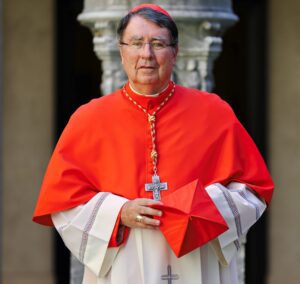
 Candler’s Aquinas Center of Theology will welcome Cardinal Christophe Pierre, Apostolic Nuncio to the United States, to present the 2024 Major Catholic Speaker Lecture on February 20 at 7:30 p.m. in Cannon Chapel sanctuary. The in-person event is free and open to the public with advance registration required.
Catholic dignitaries in the role of Apostolic Nuncio serve as the Vatican’s diplomatic ambassador to their designated country. As the official envoy from the pope to the U.S., Pierre will focus his lecture on synodality, a concept Pope Francis has emphasized throughout his decade of pontifical leadership.
“Pope Francis has called the Roman Catholic Church to become a church characterized by synodality,” says Aquinas Center Executive Director Greg Hillis. “This looks like a church characterized by engagement with the world, by dialogue, and by listening to the voices of all, particularly those who have been marginalized. A synodal church is a church that honors and recognizes the dignity and voices of all people.”
In 2021, Pope Francis launched a synod—a process of consultation and listening rooted in the church’s ancient tradition—to learn more about life and relevant issues within local Catholic communities in this day and time, calling on the entire Roman Catholic Church to take part.
Titled “For a synodal Church: communion, participation, and mission,” the three-year process has taken place at the community and archdiocesan levels around the world, with official reports on congregational listening sessions sent to the Vatican for review. In the fall of 2023, the first meeting of the Synod on Synodality took place at the Vatican. Bringing together the voices of bishops, priests, religious, and laypeople, this Synod will meet again in the fall of 2024 to discern the ways in which synodality can be incorporated into the church.
Learn more about the synod’s purpose and progression on the Aquinas Center website.
A description of Pierre’s lecture is below.
“The Vision of Pope Francis for a Synodal Church”
What is the practical relevance of synodality? And what does synodality look like at the parish/community level? Synodality has always been a fundamental attribute of the Church, because the Body of Christ follows the pattern of ministry set forth by its Head, the Son of God who became human precisely so that he could “walk together” with his creatures and join the human reality to the fullness of divine life. In this lecture, Cardinal Pierre will discuss what this synodal approach is and why it is all the more vital today. Only through synodality, only through an open listening and a “being with” the people of our day, will we be able to discern, following the action of the Holy Spirit, the way to bring people to an encounter with Christ.
Pierre was ordained a priest in 1970 and incardinated in the Archdiocese of Rennes. He earned a master’s in sacred theology and a doctorate in Canon Law from the Pontifical Lateran University, Rome. He completed his studies at Rome’s Pontifical Ecclesiastical Academy and joined the Diplomatic Service of the Holy See in 1977.
He was appointed first to the Pontifical Representation in New Zealand and the Islands of the Pacific Ocean. Subsequently he served in Mozambique, Zimbabwe, Cuba, Brazil, and at the Permanent Mission of the Holy See to the United Nations in Geneva, Switzerland. He was appointed Apostolic Nuncio and elected Titular Archbishop of Gunela in 1995, receiving Episcopal Consecration on September 24, 1995, in Saint-Malo, France.
Prior to his appointment to the United States by Pope Francis, Pierre served as Apostolic Nuncio to Haiti (1995–1999), Uganda (1999–2007), and Mexico (2007–2016).
In July of 2023, Pope Francis announced his intention to elevate Pierre to the College of Cardinals. At the Public Consistory of September 30, 2023, Pierre was made Cardinal Deacon of San Benedetto fuori Porta S. Paolo.
“The topic of synodality is of vital importance for the church today, and I can think of no one better suited to unpack the meaning of synodality for our American context than Cardinal Pierre,” says Greg Hillis.