


Phillips presides over Holy Communion in Cannon Chapel in 2023.
It’s been said that a Candler education teaches students to serve with their head, heart, and hands—all three, woven together. This metaphorical braid is also true of the Candler faculty, and certainly when it comes to the teaching career of Associate Professor of Historical Theology and Christian Worship L. Edward “Ed” Phillips 79T.
Phillips retires this spring after 18 years on the Candler faculty. It’s a milestone that closes the most recent chapter of a story that began 50 years ago, when he and his wife, the Rev. Sara Webb Phillips 79T—newlyweds of just a week—arrived in Atlanta from Tennessee to begin both their marriage and their seminary journey.
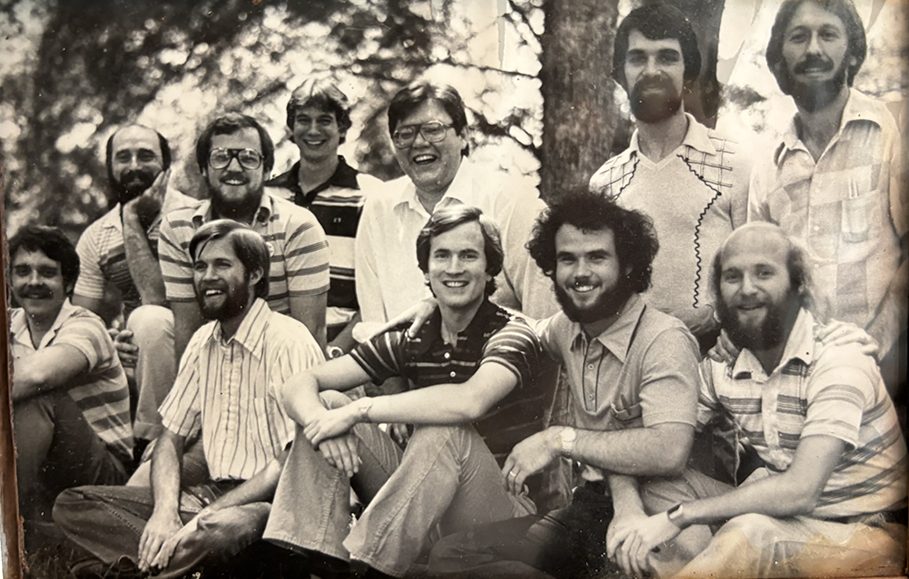
The men’s small group at Candler that Phillips (far left, first row) helped start as a student in the late 1970s.
“My life, and Sara’s too, is truly unimaginable without Candler,” Phillips says now. “We met some of our dearest friends during our first year.” As a student, he helped begin a men’s small group, inspired by the women of Candler who so naturally supported one another. “Our men’s group was spiritual, emotional, vocational, and topical.” They discussed social and political issues of the day—the growing leadership of women in the church, LGBTQ rights, the aftermath of Vietnam and more, all set against the backdrop of the Carter Administration.
Like many, Phillips enrolled at Candler to prepare to serve in parish ministry. By his third year, he had begun to feel a call to doctoral studies. After graduating he served for two years as a local pastor in the Memphis Annual Conference of The United Methodist Church, and three years at Tennessee’s Lambuth College as co-dean (alongside Sara) of students and college chaplains. He then returned to the classroom, this time as a PhD student in liturgical studies at the University of Notre Dame.
But even as Phillips transitioned to being primarily a teacher and scholar, he’s never left his pastoral vocation behind. It is a deep part of his soul, and of his scholarship.
After all, he is a professor of worship, called to guide the next generation of church leaders through the nuanced history of Christian community—the practical and the sacred—and how these layers inform the present. He has authored numerous articles, book reviews and books, including The Purpose, Pattern, and Character of Worship (Abingdon Press, 2020), and served as general editor and contributor to the revised and updated fourth edition of James White’s Introduction to Christian Worship (Abingdon, 2023).
Students and alumni alike say there is a pastoral presence to his teaching. Sangeon Kim 24T recalls that Phillips’ History of Early Christianity course was his very first at Candler “after arriving in this unfamiliar and distant land” from South Korea.
“Because Dr. Phillips taught the fierce debates of the early Church Fathers with a generous smile, warm language, and a gracious atmosphere, Room 252 was like a place of ministry as well as a place of learning,” Kim says.

Phillips in his role as a faculty marshal during Candler’s 2024 graduate recognition ceremony.
Matthew Pierce 18T says that during class and office hours, Phillips showed him that “liturgy is not simply something the Church does, but something that forms who we are—both as individuals and as a community.” And while his teaching about church history possesses the scholarly rigor that Candler is known for, Pierce notes that Phillips is equally and genuinely open to new ideas around worship. “These moments with Dr. Phillips sharpened my thinking in lasting ways,” says Pierce.
Aquinas Associate Professor of Theology and Culture Antonio Alonso has also witnessed Phillips’ deep and wide perspective of his subject matter, and knows the value of it. Instead of idealizing the worship practices of the early church as some scholars do, Alonso says, “Ed has helped us to see early Christian liturgies as they were: diverse, contextual, fluid, ever-evolving practices of imperfect spirit seeking to be faithful in spirit and truth. That vision has allowed him to make liturgical history powerfully relevant in the present for students and scholars alike, helping us appreciate both unity and diversity in the worship of the church today across Christian denominations.”
His students experience Phillips’ balanced commitment to unity and diversity in his courses, and carry it into their ministerial journeys. Shinmyung Kim 25T credits Philips with helping to shape her understanding of different elements of identity—her own and others’.
“His scholarship demonstrates a thorough analysis and construction of liturgical history, practices, and styles that take into account the complexities we encounter in the church,” she says. “This has equipped me, as a future pastor, with both professional and practical knowledge and wisdom.”

Ed Phillips (third from right) and his wife, Sara, (third from left) perform in Cannon Chapel with Candler’s staff and faculty choir.
Anyone who knows him would agree that Phillips’ teaching and research aren’t complete without their many real world manifestations. Associate Dean Emerita of Worship and Music Barbara Day Miller 88T lifts up his passion for “the work of worship.”
“Ed was always engaged in the diverse ways we gathered at Candler, as observer and full participant,” says Day Miller—whether this meant sitting in the pew, preaching and presiding, or writing a new antiphonal psalm setting for the Candler Singers.
His embodied liturgy has also taken the form of the hospitality that Phillips and his family extend beyond campus, making it a regular practice to welcome faculty, staff, and students affiliated with Candler’s Methodist Studies program into their home to share meals and music.
“Ed embodies what he teaches,” Pierce says. “Evenings at his and Sara’s table in Decatur reflected a deep investment in the well-being and formation of his students and colleagues.”
“Ed plays guitar, piano, dulcimer, sings, and writes great songs,” says Professor in the Practice of Practical Theology and Methodist Studies Thomas W. Elliott Jr. 87T 97T, a songwriter himself who often joins Phillips on guitar. “Through the years, we have had great fun combining our musical interests and performing at various local church Sunday School events.”
“Until Ed’s arrival, I don’t recall gatherings of United Methodist faculty, except for matters of governance or curricular concerns,” Day Miller says. “Those delightful evenings of laughter and singing with Ed on guitar helped affirm our work, connecting us to the church and to each other.”
“Sara and I love hosting students and colleagues at our home,” says Phillips. “Some of my best memories are conversations around our dinner tables.” Yes, that’s tables, plural. “We have more than one!”

The author’s children dance to the music of Candler faculty Brett Opalinski, Ed Phillips, and Tom Elliott during an event at the Phillips home.
(Indeed, this writer will take a paragraph of personal privilege to echo the chorus of fond memories at the Phillips home—especially singing alongside fellow staff, professors, deans, and their families while my own children danced with joyful abandon to Phillips’ dulcimer and the guitars of Elliott and Assistant Dean of Methodist Studies Brett Opalinski 98T.)
In the last decade, both Phillips’ scholarship and his embodied commitment to worship have intersected with global events. This is not a surprise to his Candler colleagues. “Ed is a deep thinker with strong convictions about life and faith, which he lives out in service to others and the church,” says Elliott.
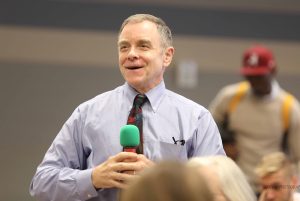
Phillips speaks during a Candler event in 2018.
In the midst of the COVID-19 pandemic, Phillips spearheaded the creation of the interdisciplinary consultation “Ecumenical Protocols for Worship, Fellowship, and Sacrament during a Pandemic.” The consultation connected more than 60 theologians, scientists, doctors, bishops, pastors, and practitioners from multiple denominations who worked to develop medically sound and theologically informed recommendations for in-person worship and sacramental practice as churches began to reopen.
To extend the document’s impact, the recommendations were published in English and Spanish. To ensure medical accuracy, Phillips and the leadership team sought feedback from public health workers at the Centers for Disease Control and Prevention (CDC). “Our collaboration with CDC made the project unique among the various religious organizations providing such guidance,” he says.
Phillips has also lived out his vocations through his relationships with Christian communities in the Middle East. He and Sara have led witness and solidarity trips to Israel and Palestine through a Christian Palestinian nonprofit. It’s a connection he hopes to strengthen in retirement. “To bring people to witness what is happening in Palestine is significant to me personally, and I hope I am making a difference in how American Christians understand the situation in Gaza and the West Bank,” he says. “I have developed a deep love for the indigenous Christian communities in Palestine, and a deep appreciation for Muslim and Jewish friends and organizations that are working for Palestinian liberation.”
“His moral clarity and passion around justice for the least among us testifies to a vision of liturgy that is inextricably bound to ethics,” says Alonso.
A prime example of this is one of Phillips’ most meaningful Candler memories: when professors joined together to support students protesting Emory University’s response to a pro-Palestinian encampment on campus in the spring of 2024. “Several of us took turns staying late into the evening to maintain a faculty presence as our atrium became the one place where people could find food and an open bathroom,” Phillips recalls. “I continue to share that story with colleagues who ask about Candler and its real-world commitments.”
After fifty years of claiming Candler as both student and scholar, Phillips knows how blessed his experience has been. “Every day of my time here, I have felt amazement and joy at the privilege of working with such dedicated students and colleagues,” he says. “I’m still so honored that Dean Jan Love invited me to join the faculty in 2008. And I hope to continue to be of use to Candler, even in retirement.”

Phillips recesses after Candler’s 2026 graduate recognition ceremony.
The chorus to musician David Byrne’s song “Every Day is a Miracle” stays close in his heart, and at the bottom of his email signature.
Every day is a miracle
Every day is an unpaid bill
You’ve got to sing for your supper
Love one another
If the legacy he leaves through his students is any indication, he’s certainly gotten it right.
“Through Dr. Phillips’ personal presence, I have learned humility—as one who stands simply as a child of God—and have been inspired to practice a hospitality that extends not only to my neighbors, but beyond them,” Shinmyung Kim says.
“In many ways, Dr. Phillips has encouraged me to grow into a better person. His influence continues to shape me even beyond my time at Candler.”
___________________________________
Photos: 3,7 by Cindy Brown 09T; 4 by CeCe Jefferson 20T 27T; others by Candler staff.